Welcome to Our Alpha Shooters Community Forum

We'd love to welcome you on board, join today!

A7R5: 15 mp vs 61 mp for star tracker astro shots?

rcreamer

Newcomer
Followers
0
Following
0
Joined
Dec 17, 2025
Posts
18
Likes Received
14
Trophy Points
3
Name
Richard Creamer
CC Welcome
  1. Yes
I was wondering, does anyone knows if the 4x additional memory/processing burden for 61 mp vs 15 mp for high-iso star tracker tracked images is worth it? [A7R5]

Especially since:

• The 15 mp doesn't need Bayer interpolation vs the 61 mp which does

• The inherently lower pixel data value accuracy for low-brightness high-iso images

• The cumulative minor sub-pixel alignment (registration) errors when stacking dozens of noisy images with lens abberations, imperfect polar alignment, etc

• The additional SDXC card, hard drive, memory footprint + the additional CPU burden through all the post processing steps

I'm just getting started with a Star Adventurer GTi and knowing that 15 mp data is essentially as good as 61 mp data would greatly reduce the memory and processing time.

Thanks in advance.

PS: I'm new here so any suggestions on how to improve this posting such as Tags are welcome.
 
Update:

About 10 minutes ago I entered a tweaked version of my original post/question below into [Perplexity] [dot] [ai].

Its answer is: go with 15 mp for astro.

I decided not to withdraw my question/post here because it may very well be of interest to other astrophotographers here. Also, I'd enjoy any discussion of this topic here:)

I recommend pasting the below into Perplexity as I certainly learned a thing or two:)

-------

Question text entered into Perplexity:

I was wondering, is the 4x additional memory/processing burden for 61 mp vs 15 mp for high-iso star tracker tracked images is worth it? [A7R5]

Note: this question is not about capturing 61 mp and then downsizing that to 15 mp. It is about capturing 15 mp images natively in-camera using the Sony a7r5's 15 mp lossless compression raw capture mode.

Especially since:

• The 15 mp doesn't need Bayer interpolation vs the 61 mp which does

• The inherently lower pixel data value accuracy for low-brightness high-iso images

• The cumulative minor sub-pixel alignment (registration) errors when stacking dozens of noisy images with lens abberations, imperfect polar alignment, etc

• The additional SDXC card, hard drive, memory footprint + the additional CPU burden through all the post processing steps

I'm just getting started with a Star Adventurer GTi and knowing that 15 mp data is essentially as good as 61 mp data would greatly reduce the memory and processing time.
 
I must admint, i dont know anything about astrophotography.
 
In a nutshell, astrophotography is difficult because:

• Stars are very dim.
• Digital sensors' pixel values are very inaccurate for dim pixel values --> noisy images. Plus, high ISO adds more noise.
• It is impractical to "expose to the right" to fix the noise.
• So astrophotographers take many shots and average the pixel values (stack) to reduce the noise.
• Stars make star trails because of the Earth's rotation.
• Telescopes and star trackers can rotate at one revolution per day to counteract the apparent star motion. This enables the capture of many longer-exposure (say 2 minutes) images to stack but you have to aim the mount's polar axis at the north celestial pole very accurately.
 
you have to aim the mount's polar axis at the north celestial pole very accurately.
Equatorial mounts need this but most Motorized heads will use your GPS location to adjust the speed.
 
Equatorial mounts need this but most Motorized heads will use your GPS location to adjust the speed.
Thank you! I wasn't aware of this (possibly due to the poor documentation). Also, I was trying to be brief (nutshell).
 

* Please Consider Becoming a Site Supporter To Remove These Ads *

If you are going to do serious Astro photography you need an equatorial mount.

As far as your original question, if it was me I would be using the full 60MP. I certainly wouldn’t be taking too much notice of any AI. Really best to do your own testing to be honest.

What lens/lenses will you be using? What are you interested in taking photos of? Do you have access to very dark skies?
 
If you are going to do serious Astro photography you need an equatorial mount.

As far as your original question, if it was me I would be using the full 60MP. I certainly wouldn’t be taking too much notice of any AI. Really best to do your own testing to be honest.

What lens/lenses will you be using? What are you interested in taking photos of? Do you have access to very dark skies?
Thanks for your reply.

> If you are going to do serious Astro photography you need an equatorial mount.

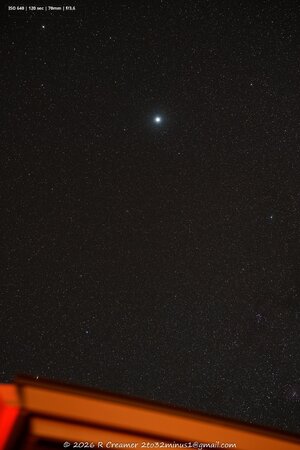
I just got a Sky Watcher Star Adventurer GTi which is an equatorial mount. I've only been able to use it once so far to see if I can do a decent job of polar alignment. See attached test photo from my deck with my roofline visible (ISO 640, 70mm, f/3.5, 120 sec, Sony 24-70mm II, a7r5). I took this shot to evaluate how good a job I did on the polar alignment since I've read that the farther away from Polaris, the more alignment errors become apparent. The ecliptic is about 66 degrees south from Polaris so this photo which includes Jupiter (which lies in the ecliptic) seemed to be a good test. The stars seem to have only a bit of elongation to me (very much a novice) and I was pretty happy with these results for a first try. But there is still some room for improvement. I'm taking things gradually and will stick with the basic built-in polar scope reticle alignment method initially. Later I'll progress to 2- and 3-star alignment but only if I need to.

> As far as your original question, if it was me I would be using the full 60MP. I certainly wouldn’t be taking too much notice of any AI. Really best to do your own testing to be honest.

Thanks for that. Perplexity is very good at finding and summarizing information on the web. It always includes links to the sources of information it used. I only asked my question in Perplexity *after* my initial post here which included my own reasons for thinking that 61 mp may not be justified. Perplexity's response reinforced my own thinking and included additional reasons for why 61 mp may not be significantly better vs 15 mp to justify the additional overhead. I know a bit about image processing having written commercial medical imaging software in the past, so my reasons for questioning the benefits of 61 vs 15 mp for astrophotography had merit.

> What lens/lenses will you be using?

Initially, just my normal lenses:
• Sony 24-70mm II
• Sony 70-200mm II
• Zeiss 18mm Batis

I may want to get a 1.4x teleconverter.

I'm really trying to avoid getting a large telescope (had a 10" reflector long ago) or even a modest 5" refractor. At most I may get a small 8 pound 300-400mm refractor, but not for at least 6 months.

> What are you interested in taking photos of?

I want to target objects like M31/ Andromeda, the Pleiades, and the objects in Cygnus, Cassiopeia, Ursa Major etc. Also I'll be targeting meteor showers.

> Do you have access to very dark skies?

I live in a Bortle 3.5-4 area and can drive to a Bortle 1.5 area in about 2 hours.
 

Attachments

  • _DSC6945_enh.jpg
    _DSC6945_enh.jpg
    644.1 KB · Views: 3
So you are going for deep sky stuff then, rather than just the Milky Way. I recently bought a pre-owned ZWO Seestar S50 on YouTube. Really only got to use it on Thursday night for the first time and I really don't know what I'm doing yet. It's a steeper learning curve than I thought at first.
 
Yes, nebulae, galaxies, star clusters, comets, and meteor showers:) Whatever my lenses are capable of imaging.

I recently quit Facebook and other social networks but recall many impressive posts taken with the Seestars - good luck!

Here's a link to an impressive astrophotography portfolio many of which I want to try to capture:


His review of an older Star Adventurer was what triggered my decision to buy a star tracker and get into astrophotography.
 

New in Marketplace

Back
Top