
In this guide I test 23 CFexpress Type A cards and 28 UHS-II SD cards in the 33-megapixel Sony A7 IV full-frame mirrorless camera. Measuring real-world in-camera performance versus the speeds printed on the card labels.
But first off, just in case you are unaware, the Sony A7 IV features two memory card slots.
Slot one is a dual slot that is compatible with the CFexpress Type A (2.0 & 4.0) cards and also SD/SDHC/SDXC (UHS-II / UHS-I) cards.
Slot two only supports SD/SDHC/SDXC (UHS-II / UHS-I) cards.

Table of Contents[Hide][Show]
- Introduction
- Best CFexpress Type-A Memory Cards
- Best UHS-II SD Memory Cards
- About These Tests
- Which Memory Cards are Supported?
- Max Burst by File Type & Buffer Clearing Times
- Memory Cards for Recording Video
- Memory Cards for S&Q Motion Shooting
- What Size Memory Card Do You Need?
- How Many Images Can Be Recorded on a Memory Card?
- Movie Record Times
- Simultaneous Recording Slot 1 + Slot 2
- Sort RAW / JPEG
- Dual Card Setup Guide
- Summary
- Sony A7 IV Guides & Resource
- FAQs
Introduction
The write speeds found on card labels don’t really help with understanding how the cards will perform when used in-camera, especially when they often display the maximum speeds and not sustained speeds.
I’ve therefore tested 51 memory cards to get the best possible idea of how they perform when used in the A7 IV.
Best CFexpress Type-A Memory Cards
In the below table you will find all of the CFexpress Type A cards that I have tested so far shooting Uncompress RAW + JPEG L (Extra Fine), since this combination pushes the camera and cards the hardest.
I have tested other file combinations but not for every card, please scroll down to Buffer Test – All File Types if interested.
You can comfortably shoot over 300 shots before filling the buffer when shooting in Uncompressed RAW + JPEG L (Hi+) with all but four of the CFexpress Type A cards tested. I don’t shoot more because I don’t think anyone is doing this in the real world.
Because their performance is so similar, I have grouped them by brand. Except for the slowest four cards that you will find at the bottom of the table.
These results are only valid for the card capacities tested, because sometimes write speeds can vary by capacity.
Swipe left on mobile to view the entire table.
| CFexpress Type A Memory Card | Shots to Fill Buffer * | Buffer Clearing Time in Seconds | Video Rating |
|---|---|---|---|
 Novachips Express 4.0 (1.6 TB) Amazon | Memory Wolf UK | 300+ | <2s | VPG400 |
 Novachips Express 4.0 (400 GB) Amazon | Memory Wolf UK | 300+ | <2s | VPG400 |
 Delkin Devices BLACK 4.0 (480 GB) Amazon | B&H Photo | Memory Wolf UK | 300+ | <2s | VPG200 |
 Delkin Devices POWER 2.0 (160 GB) Memory Wolf UK | 300+ | <2s | VPG400 |
 Nextorage NX-A2 PRO 4.0 (160 GB) Amazon | B&H Photo | 300+ | <2s | VPG400 VPG800 |
 Nextorage NX-AE 4.0 (500 GB) Amazon | B&H Photo | 300+ | <2s | VPG400 |
 Nextorage NX-A2SE 4.0 (512 GB) Amazon | B&H Photo | 300+ | <2s | VPG200 |
 SanDisk Pro Cinema 4.0 (480 GB) Amazon | B&H Photo | 300+ | <2s | VPG200 |
 ProGrade Digital Iridium 4.0 (480 GB) Amazon | B&H Photo | 300+ | <2s | VPG200 |
 Lexar Professional Gold Series 2.0 (160 GB) Amazon | B&H Photo | 300+ | <2s | VPG400 |
 Lexar Professional Silver Series 2.0 (320 GB) Amazon | 300+ | <2s | VPG200 |
 Lexar Professional GOLD 4.0 (256 GB) Amazon | B&H Photo | 300+ | <2s | VPG400 |
 Angelbird AV PRO 2.0 SE (160 GB) Amazon | B&H Photo | Memory Wolf UK | 300+ | <2s | VPG200 |
 Angelbird AV PRO 4.0 (256 GB) Amazon | B&H Photo | Memory Wolf UK | 300+ | <2s | VPG400 |
 OWC Atlas Pro 4.0 (240 GB) Amazon | B&H Photo | 300+ | <2s | VPG200 |
 Exascend Essential 2.0 (480 GB) Amazon | 300+ | <2s | VPG200 |
 Sony CEA-G Tough 2.0 (160 GB) Amazon | B&H Photo | 300+ | <2s | VPG400 |
 Sony CEA-G Tough 4.0 (240 GB) Amazon | B&H Photo | 300+ | <2s | VPG400 |
 Sony CEA-M Tough 2.0 (960 GB) Amazon | B&H Photo | 300+ | <2s | VPG200 |
 Lexar Professional SILVER 4.0 (256 GB) Amazon | B&H Photo | 283 | <2s | VPG200 |
 ProGrade Digital 2.0 Gold 2.0 (240 GB) Amazon | B&H Photo | 97 | 3s | VPG200 |
 Nextorage NX-A2SE 4.0 (256 GB) Amazon | B&H Photo | 29 | 3s | VPG200 |
 Pergear Master 4.0 (256 GB) Amazon | 15 | 3s | VPG200 |
Please note that the Nextorage NX-A2SE 4.0 (256 GB) card has a much slower sustained write speed than the larger 512 GB version which is why the buffer clears slower. The 256 GB card has a sustained write speed of 400 MB/s vs 850 MB/s for the 512 GB version. The max write speeds on the card labels are identical which makes it very confusing. The Pergear Master 4.0 256 GB also has a slower sustained write speed than the 512 GB version, hitting the buffer after only 15 shots. Subsequent bursts it manages 88 shots sometimes but it’s not consistent at all.
Best UHS-II SD Memory Cards
In this table you will find all of the UHS-II SD cards that I have tested in the Sony A7 IV shooting Uncompress RAW + JPEG L (Extra Fine), since this combination pushes the camera and cards the hardest.
I have tested other file combinations but not for every card, please scroll down to Buffer Test – All File Types if interested.
Unlike the CFexpress Type A cards, there is much more variance in performance. I have therefore ranked them by buffer clearing time.
Like with the CFexpress cards, the results are only valid for the card capacities tested.
Swipe left on mobile to view the entire table.
| UHS-II SD Memory Card | Shots to Fill Buffer * | Buffer Clearing Time in Seconds | Video Speed Class |
|---|---|---|---|
 Nextorage NX-F2 PRO (256 GB) B&H Photo | Amazon | 17 | 4.5s | V90 |
 SanDisk Extreme Pro (64 GB) B&H Photo | Amazon | Memory Wolf UK | 17 | 4.5s | V90 |
 Sony SF-G Tough (64 GB) B&H Photo | Amazon | Memory Wolf UK | 17 | 4.5s | V90 |
 Delkin Devices BLACK (64 GB) B&H Photo | Memory Wolf UK | 17 | 4.5s | V90 |
 Delkin Devices POWER (64 GB) B&H Photo | Amazon | Memory Wolf UK | 17 | 4.5s | V90 |
 ProGrade Digital V90 Iridium (128 GB) B&H Photo | Amazon | 17 | 4.5s | V90 |
 OWC Atlas Ultra (128 GB) B&H Photo | Amazon | 17 | 4.5s | V90 |
 Integral UltimaPro X2 (64 GB) Amazon | 17 | 4.5s | V90 |
 ProGrade Digital V90 300R (64 GB) B&H Photo | Amazon | 17 | 5s | V90 |
 Lexar Professional 2000X (64 GB) B&H Photo | Amazon | Memory Wolf UK | 17 | 5s | V90 |
 PNY EliteX-PRO 90 (64 GB) B&H Photo | Amazon | 15 | 5s | V90 |
 Angelbird AV Pro Mk 2 V90 (64 GB) B&H Photo | Amazon | Memory Wolf UK | 17 | 5s | V90 |
 Angelbird AV Pro Mk 2 V90 (128 GB) B&H Photo | Amazon | Memory Wolf UK | 17 | 5s | V90 |
 Transcend SD 700S (64 GB) B&H Photo | 17 | 5s | V90 |
 Kingston Canvas React Plus (64 GB) B&H Photo | Amazon | Memory Wolf UK | 15 | 5s | V90 |
 Exascend Catalyst (128 GB) B&H Photo | Amazon | 16 | 5.5s | V90 |
 Ritzgear Video Pro (64 GB) Amazon | 17 | 5.5s | V90 |
 Lexar Professional 1800X (64 GB) B&H Photo | Amazon | 16 | 6s | V60 |
 Sony SF-E (128 GB) B&H Photo | Amazon | Memory Wolf UK | 16 | 6s | V60 |
 Nextorage NX-F2 SE (512 GB) B&H Photo | Amazon | 16 | 6.5s | V60 |
 Sony SF-M Tough (128 GB) B&H Photo | Amazon | Memory Wolf UK | 15 | 7.5s | V60 |
 Sony SF-M (64 GB) B&H Photo | Amazon | 15 | 7.5s | V60 |
 ProGrade V60 (128 GB) B&H Photo | Amazon | 14 | 8s | V60 |
 Lexar Professional Silver Pro (128 GB) Amazon | 14 | 9s | V60 |
 Angelbird AV Pro MK2 V60 (64 GB) B&H Photo | Amazon | Memory Wolf UK | 14 | 11s | V60 |
 SanDisk Extreme Pro (64 GB) B&H Photo | Amazon | 14 | 12s | V60 |
 Lexar Professional 1667X (64 GB) B&H Photo | Amazon | Memory Wolf UK | 14 | 13s | V60 |
 Sony SF-E (64 GB) B&H Photo | Amazon | Memory Wolf UK | 13 | 15s | V30 |
About These Tests
All of my in-camera tests were carried out with the Sony A7 IV and firmware 4.00 whilst shooting in Uncompressed RAW + JPEG L (Extra Fine). All figures presented in this article are based on my test conditions.
You will most likely see slightly different results when running similar tests because a different scene will generate different file sizes. My test scene generated 70.1 MB Uncompressed RAW files and 23.7 MB JPEG L Extra Fine files.
When shooting with these file sizes in Hi+ (6 fps) the A7 IV is writing at an average speed of approximately 560 MB/s. It basically never fills the buffer because the fastest CFexpress cards are able to write fast enough to avoid filling it.
I chose to use Uncompressed RAW + JPEG L for my tests because this pushed the cards harder than testing with Compressed RAW + JPEG L, even with the frame rate at 10 fps.
My results are only valid for the card capacities tested, because sometimes write speeds can vary by capacity.
Which Memory Cards are Supported?
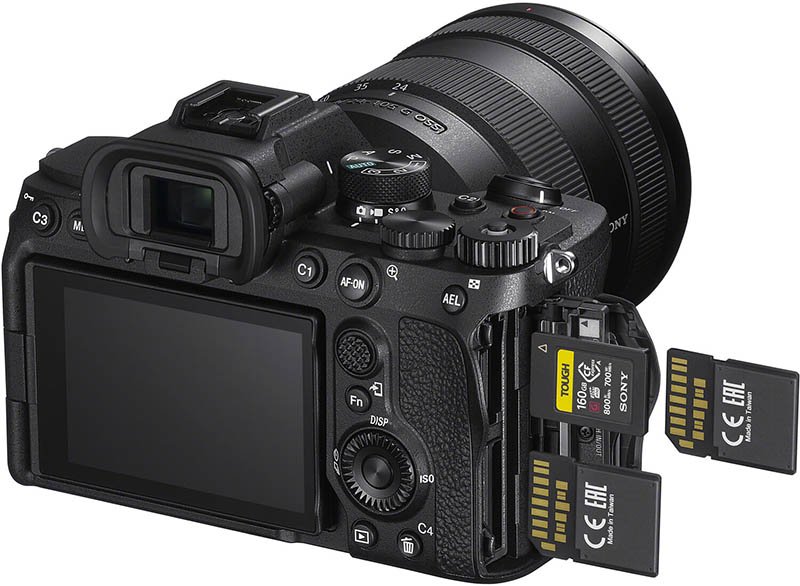
The Sony A7 IV has two memory card slots, here are the cards that each slot supports:
- Slot 1: CFexpress Type A (2.0 & 4.0) and UHS-I and UHS-II (SDHC/SDXC) SD cards
- Slot 2: Only UHS-I and UHS-II (SD/SDHC/SDXC) cards
CFexpress Type A 4.0 cards will work in the A7 IV because they are backwards compatible with the 2.0 standard, but you will not be able to take advantage of 4.0 speeds in-camera.
Max Burst by File Type & Buffer Clearing Times
I don’t test every single file type for every single card because I’d certainly lose the will to live.
But if you are interested, then here are the approximate figures when using the Novachips Express 4.0 400 GB card.
The JPEG Quality/HEIF Quality was [Extra Fine] and Image Size: [L:33M].
| File Type | Shots to Fill Buffer * | Buffer Clearing Time in Seconds |
|---|---|---|
| JPEG | 300+ | <2s |
| HEIF | 300+ | <2s |
| RAW & JPEG (RAW: Uncompressed) | 300+ | <2s |
| RAW & HEIF (RAW: Uncompressed) | 300+ | <2s |
| RAW (Uncompressed) | 300+ | <2s |
| RAW & JPEG (RAW: Compressed) | 300+ | <2s |
| RAW & HEIF (RAW: Compressed) | 300+ | <2s |
| RAW (Compressed) | 300+ | <2s |
| RAW & JPEG (RAW: Lossless Compressed L) | 300+ | <2s |
| RAW & HEIF (RAW: Lossless Compressed L) | 300+ | <2s |
| RAW (Lossless Compressed L) | 300+ | <2s |
| RAW & JPEG (RAW: Lossless Compressed M) | 300+ | <2s |
| RAW & HEIF (RAW: Lossless Compressed M) | 300+ | <2s |
| RAW (Lossless Compressed M) | 300+ | <2s |
| RAW & JPEG (RAW: Lossless Compressed S) | 300+ | <2s |
| RAW & HEIF (RAW: Lossless Compressed S) | 300+ | <2s |
| RAW (Lossless Compressed S) | 300+ | <2s |
Memory Cards for Recording Video
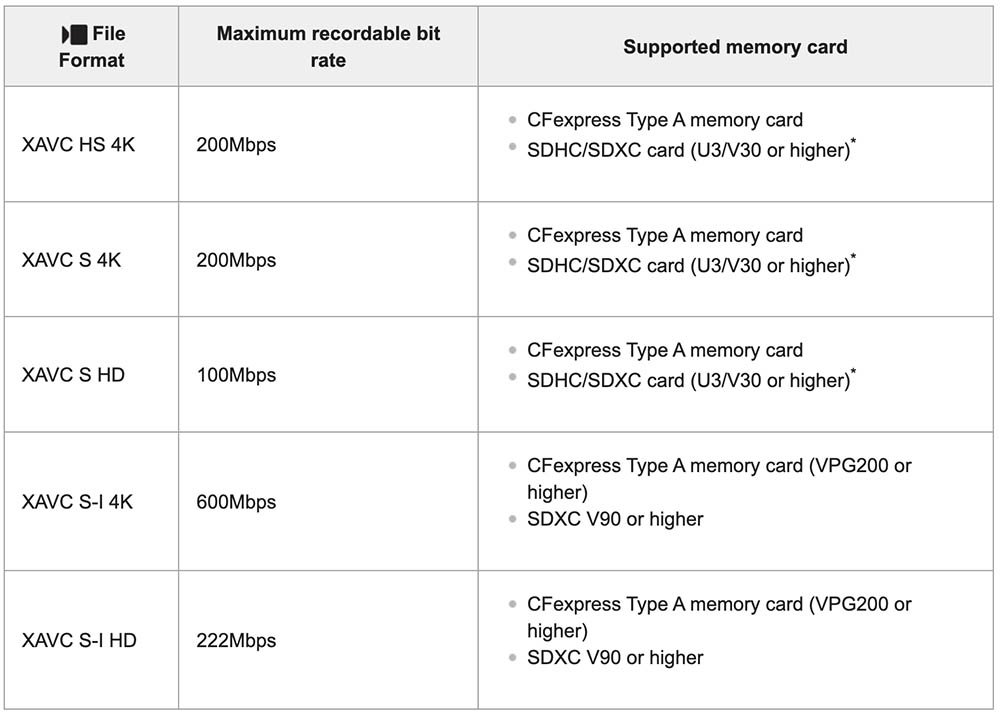
The Sony A7 IV supports a number of different movie recording formats. The format that you choose to record in will determine the memory cards that you use. Here’s a list or supported recording formats and compatible memory cards for the A7 IV.
Memory Cards for S&Q Motion Shooting
Here you can find a list of supported recording formats and compatible memory cards for S&Q motion shooting with the A7 IV.
You will only require a CFexpress Type-A card when shooting in S&Q Mode with the file format set to XAVC S-I 4k, a record frame rate of 25p and a frame rate of 50fps (2x slow motion).
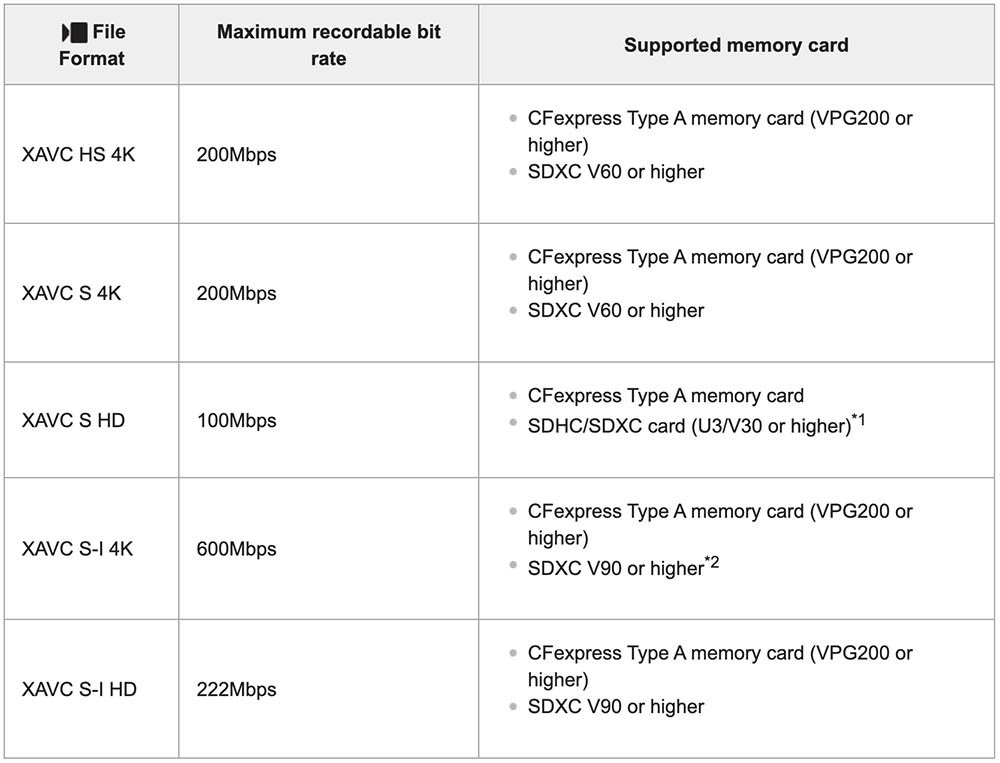
*1 When [Rec Frame Rate] is set to [30p]/[25p]/[24p], [Frame Rate] is set to [120fps]/[100fps], and the recordable bit rate is set to 50 Mbps, an SDXC card (V60 or higher) or a CFexpress Type A memory card (VPG200 or higher) is required.
*2 When [Rec Frame Rate] is set to [30p]/[25p]/[24p] and [Frame Rate] is set to [60fps]/[50fps] for slow-motion recording, a CFexpress Type A memory card (VPG200 or higher) is required.
What Size Memory Card Do You Need?
If you will be shooting a lot of continuous bursts then you will probably want to use at least a 160GB CFexpress card.
If you are not shooting long continuous bursts then you’ll probably be fine with 32GB or 64GB cards and you certainly won’t need the faster CFexpress Type A cards.
For shooting video the size of memory card will depend largely on the format that you are recording in. Or you may be using an external recorder anyway so this won’t be so important.
I’d recommend only using SDXC cards and not SDHC. 32GB cards and smaller are SDHC and use the FAT32 file system. If you shoot video with a SDHC card your files will be split into 4GB chunks which creates extra work in post production.
How Many Images Can Be Recorded on a Memory Card?
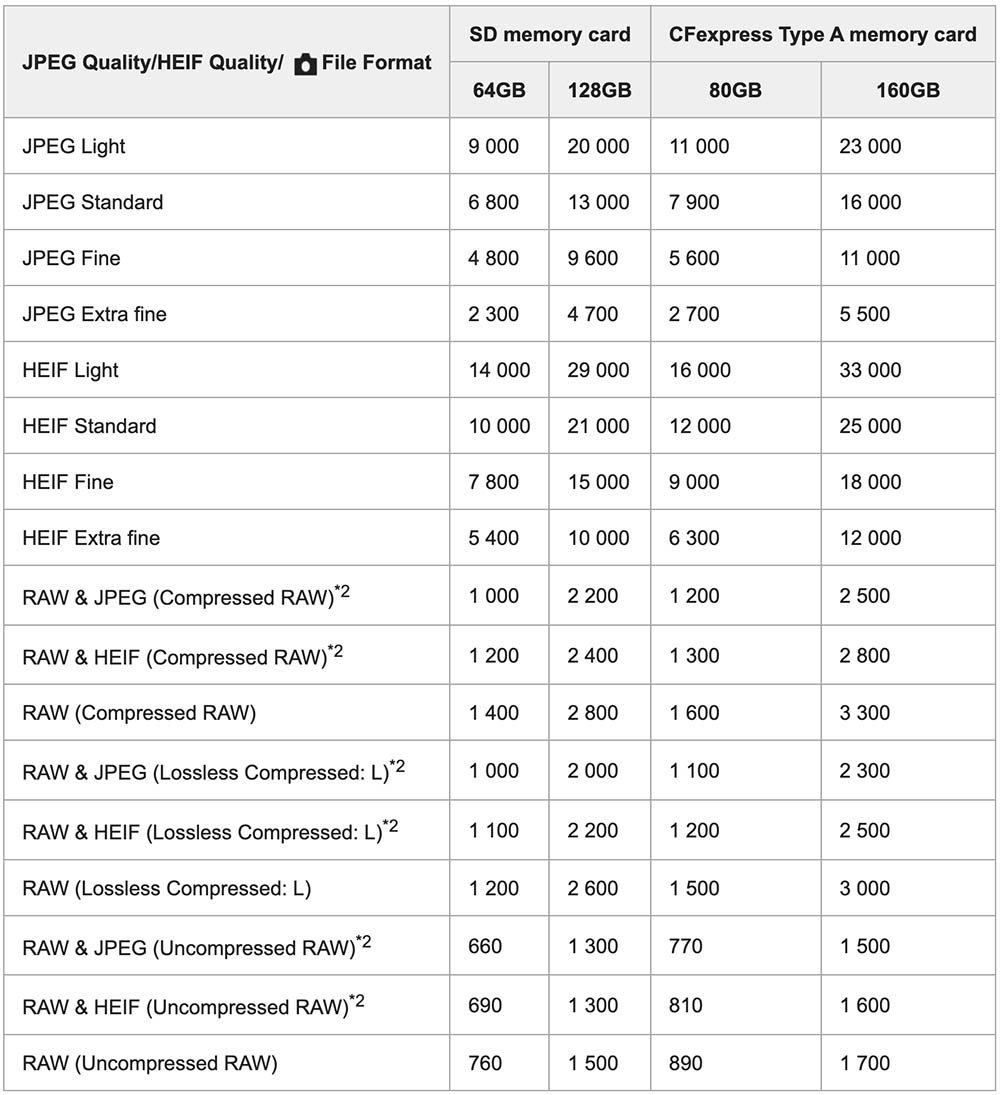
The table below shows the approximate number of images that can be recorded on a memory card formatted in the A7 IV when using a Sony memory card with the aspect ratio set to 3:2 and JPEG/HEIF size set to L:33M.
The values may vary depending on the shooting conditions and the type of memory card used.
Movie Record Times
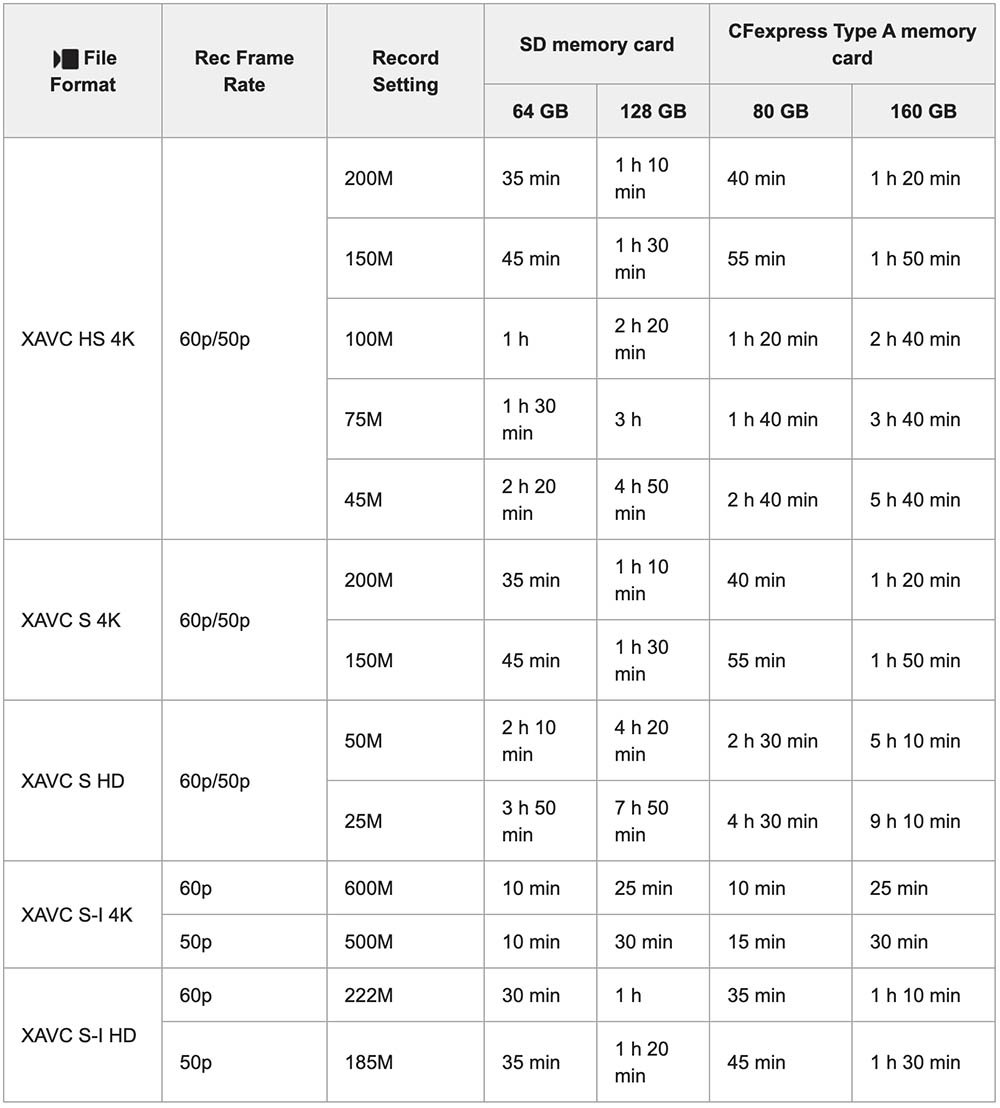
The table below shows the approximate total recording times using a Sony memory card formatted in the Sony A7 IV. The values may vary depending on the shooting conditions and the type of memory card used.
Simultaneous Recording Slot 1 + Slot 2
If you want to record simultaneously to both slots 1 and 2 at the same time then there is no benefit to using a CFexpress Type-A memory card in slot 1.
With this setup the write speed is restricted to the maximum write speed of the UHS-II card in slot 2.
The only benefit to using a CFexpress Type-A card when shooting simultaneously is to enjoy the faster read times when copying the files to your computer.
Providing you are using identical UHS-II cards in both slots then the number of shots that you can take and the buffer clearing time will be the same as writing to a single slot.
If one of the UHS-II cards is slower then you will be limited to the speed of that card.
Sort RAW / JPEG
You can also setup your A7 IV to record RAW files to slot 1 and JPEG files to slot 2. With this setup there is still a benefit to using a CFexpress card in slot 1.
If you are shooting with a fast CFexpress card and a fast V90 UHS-II card you should be able to shoot over 300+ shots without hitting the buffer.
Dual Card Setup Guide
If you are not sure how to setup dual card recording with the Sony A7 IV then you might find my short video guide helpful.
Memory Card Readers
Mixing memory card and card reader brands often works without issue, but compatibility problems can occasionally occur.
Therefore, I recommend using a card reader that matches your memory cards to reduce the risk of incompatibility. For example, if you use ProGrade memory cards, I’d recommend a ProGrade card reader; if you use Lexar cards, a Lexar reader is the best choice, and so on.
Also keep in mind that transfer speeds will always be limited by either the reader or the maximum card speeds. So don’t be tricked into buying a reader that advertises faster transfer speeds than the cards it supports.
You will see figures like 10 Gb/s, 20 Gb/s or 40 Gb/s. These are the maximum bus speeds for the device. It’s important to note the lowercase b which indicates that this figure is Gigabits per second and not Gigabytes per second. 10 Gb/s = 1250 MB/s.
CFexpress Type A 4.0 Readers
These CFexpress readers support the faster CFexpress Type A 4.0 speeds, they are also backwards compatible with CFexpress Type A 2.0 cards.
| CFexpress Type A 4.0 Reader | * Max Transfer Speed | Price Check |
|---|---|---|
| ProGrade Digital CFexpress 4.0 | 2000 MB/s | B&H Photo | Amazon |
| Nextorage NX-SA1PRO CFexpress 4.0 | 2000 MB/s | B&H Photo | Amazon |
| Novachips CFexpress 4.0 | 2000 MB/s | Memory Wolf UK | Amazon |
| Sony MRW-G3 CFexpress 4.0 | 2000 MB/s | B&H Photo | Amazon |
| Lexar Professional Workflow 4.0 | 2000 MB/s | B&H Photo | Amazon |
CFexpress Type A 2.0 Readers
These CFexpress readers support CFexpress Type A 2.0 speeds, they compatible with CFexpress Type A 4.0 cards but will only transfer data at 2.0 speeds.
| CFexpress Type A 2.0 Reader | * Max Transfer Speed | Price Check |
|---|---|---|
| Angelbird PKT CFexpress 2.0 | 1000 MB/s | B&H Photo | Amazon |
CFexpress Type A 2.0 + SD Dual Slot Readers
These dual readers support CFexpress Type A 2.0 cards, they are compatible with CFexpress Type A 4.0 cards but will only transfer data at 2.0 speeds. They also support SD/SDHC/SDXC (UHS-II / UHS-I) memory cards.
| CFexpress Type A 2.0 + SD Reader | * Max Transfer Speed | Price Check |
|---|---|---|
| Sony MRW-G2 | 1000 MB/s | B&H Photo | Amazon |
| ProGrade Digital | 1000 MB/s | B&H Photo | Amazon |
| Lexar Professional | 1000 MB/s | B&H Photo | Amazon |
UHS-II SD Card Readers
These card readers only support SD/SDHC/SDXC (UHS-II / UHS-I) memory cards.
| UHS-II SD Card Reader | * Max Transfer Speed | Price Check |
|---|---|---|
| Lexar Professional Workflow Dual-Slot | 312 MB/s | B&H Photo | Amazon |
| SanDisk Extreme Pro SD Card USB Type-C | 312 MB/s | B&H Photo | Amazon |
| Kingston Mobilelite Plus | 312 MB/s | B&H Photo | Amazon |
| Sony MRW-S1 UHS-II SD Memory Card Reader | 312 MB/s | B&H Photo | Amazon |
Summary
As you are now probably well aware, there are a lot of CFexpress Type A and UHS-II SD cards on the market, figuring out the best ones for your needs and budget can be a challenge.
However, with the performance of most CFexpress Type A cards very similar, you might simply want to just go with your favorite brand, or the ones that matches your budget.
Nextorage is definitely a brand worth considering. They are a Japanese company run by former Sony employees and their cards are seriously good.
Novachips are also not very well known but offer some brilliant cards with great prices. They are probably the best performing and best value CFexpress Type A card currently available. Novachips is a South Korean company.
I’m also a big fan of the Delkin cards. They have excellent lifetime warranties and their BLACK cards also come with a 48-hour replacement guarantee in addition to their limited lifetime warranty policy. They also have US and European based support teams.
If you have any questions or can share any feedback on the cards I have tested or cards that I haven’t, please do drop a comment a below.
If you are in the UK please consider purchasing from Memory Wolf which is a store that I also run.
Thanks for reading!
Table of Contents[Hide][Show]
- Introduction
- Best CFexpress Type-A Memory Cards
- Best UHS-II SD Memory Cards
- About These Tests
- Which Memory Cards are Supported?
- Max Burst by File Type & Buffer Clearing Times
- Memory Cards for Recording Video
- Memory Cards for S&Q Motion Shooting
- What Size Memory Card Do You Need?
- How Many Images Can Be Recorded on a Memory Card?
- Movie Record Times
- Simultaneous Recording Slot 1 + Slot 2
- Sort RAW / JPEG
- Dual Card Setup Guide
- Summary
- Sony A7 IV Guides & Resource
- FAQs
Sony A7 IV Guides & Resource

FAQs
The Sony A7 IV supports CFexpress Type A memory cards in slot 1 only. UHS-I and UHS-II SD cards are also supported in both slot 1 and slot 2.
No.
Sometimes if the card has been used in another device it won’t be recognised. Try using a card reader to format or remove all files and folders with a computer, then try it again in the camera.


Thanks for this. I’m interested in the methodology behind your benchmarks and how you arrive at the average speeds. Can you share the details behind it? My math is (shots till buffer * file size)/time to clear looks off and exceeds the rated speeds. I get a lot of Chinese brands come my way and wanted to get some numbers.
Anyway, I’ve been holding off on getting CFX-A cards because of the price and I personally prefer shooting with a Ninja but some shoots really benefit from the S&Q modes which happens to require the CFX cards. Anyway, just checked-out some 256GB Kingston Canvas Reacts thanks to your recommendation. The free card reader and a 10$ cashback were a nice bonus 🙂
Hi Richard. Sorry for the slow reply. Yes you basically shoot until the buffer is full and record the total time taken to fill and clear the buffer. To calculate the average in-camera write speed I just take the number of shots taken, multiply this by the file size, then divide by the total time taken to shoot and clear the buffer. I normally repeat this 3x and average the results. Hope you are enjoying the Kingston card! 🙂
No worries and thanks for the reply. Almost forgot about it but I’m not shopping for my first CFx Type-A card and I’m back to your excellent guide. I’ve been meaning to get the Sony Tough cards since they’re the only imports I can get from a nearby country (Japan). I was curious about the “Tough” branding. Is it really as tough as they claim it to be?
THANK YOU SO MUCH fot this test !
i was disappointed abut the performance from my cam with my 170mb/s card..in a ahop they showed me aanother cam with the much more expensive 300mb/s card. and the camera slowed down nearly similar to mine. i thought
got fooled by advertising.i read somewhere abut 800 pictures in burst mode. they didn´t tell me that a cfexpress solves the problem. your test showed it clearly to me so i decided to buy cfexpress and i am happy now 🙂 searched for this information with google and came here 🙂
That to hear that the article helped Thomas! 🙂
Hi Timothy Mayo,
Thanks for the detailed review of all possible options. Its sad that the CFExpress doesnt have many options and its quite expensive to start with.
Does the CFExpress need o have a seprate card reader to copy into harddrive/PC?
Hi Ravi. Yes you will need a CFexpress Type-A reader to read the cards, or you can connect your camera directly to your computer via the USB cable. Hopefully we’ll see more CFexpress Type-A cards released this year and the prices start to come down.
> If you want to shoot in S&Q Mode with the file format XAVC S-I 4k, a record frame rate of 25p/30p and a frame rate of 50fps /60fps then you will need a CFexpress Type A card. The a7 IV will not let you record in this specific format with a V90 card.
Is this still the case with latest firmware? Everywhere I read that v90 UHS-II cards are good enough for shooting all video formats?
The a7 IV is still on its release firmware 1.00, no firmware updates have yet been released. If you shoot in S&Q mode with the settings mentioned above then yes you will need a CFexpress card. You’ll find this mentioned in the a7IV Online Manual and I’ve tested it. Alternatively you could record in one of the none S&Q video formats such as 4k60 XAVCS and then interpret the footage in post. Of course you won’t be able to view the S&Q footage in camera and this is an extra post processing step, but now you won’t require a CFexpress card and you’ll also get audio since recording in S&Q disables the audio.
Hi, thank you for your hard work.
I like to shoot 10 pictures /s. Can I use in slot A CFexpress Type A with uncompressed raw and in slot B SDXC UHS-II with jpeg? Greetings Raoul
Thank you Raoul. When shooting uncompressed raw you will always be limited to 6 frames per second with the a7 IV (see my a7 IV fps guide). You would need to shoot in compressed raw to achieve the maximum 10 fps. If you use a CFexpress Type-A card in slot 1 for the raw images and a fast UHS-II memory card such as the Kingston Canvas React Plus in slot 2 for the jpegs (shooting in sort mode) then you won’t hit the buffer. A slower UHS-II card like the Sony SF-M cards will hit the buffer after around 56 shots when shooting jpegs to slot 2. If you view the buffer data above you just need to pick a UHS-II card that doesn’t hit the buffer when shooting jpegs. Hope that helps!
Brilliant article Timothy. I’m now buying CFexpress as I want to get the top quality video recording option.
Superb level of detail here thank you.
Hello! Thank you for the great info. I am wondering if you can record straight into a Compact SSD via usb-c cable. This is how I do it on my black magic and was noticing it isn’t mentioned anywhere that the A7 IV accepts this function. Thank you!
Unfortunately recording onto an SSD drive via USB-C is not supported with the a7 IV. It would be nice if Sony’s add this to their future cameras though!
Great article Tim. After reading it, I purchased the Kingston v90 128GB SD card for my A7III. When comparing with my Lexar v60 1000x SD card, I don’t see much difference in camera. In fact, I actually got more burst shots with the Lexar in one of my test. I also used Blackmagic Disk Speed Test on my M1 MacBook Pro to test both the cards. I got W60/R151 on the Lexar which is pretty close to their advertised speed of W75/R150. However, the Kingston only got W173/R162, which is no where close to the W260/R300 advertised. Did I purchase a faulty/fake card?
Hi David. If you check my Sony a7III memory card guide you’ll see that the Kingston Canvas React Plus UHS-II don’t perform quite so well in the a7III as they do in the a7 IV. I’ve not tested the Lexar v60 1000x in the a7III but I did test the Lexar Professional 1667X UHS-II which was slower in-camera than the Kingston Canvas React Plus UHS-II. I don’t typically test the external read/write speeds as these vary quite a lot to the in-camera speeds. In-camera speeds also vary by camera model and sometimes even firmware versions. The Sony SF-G tough cards were pretty slow in the a7III until firmware 4.0 was released, then it looks like Sony quietly made some tweaks. Still, it’s strange that your much slower Lexar card isn’t as fast as the Kingston in-camera. If you bought it from a authorized reseller then it’s unlikely to be fake.
Thanks for the quick reply Tim. I ordered the A7 IV but it hasn’t arrived yet. In your opinion, is the Kingston Canvas React Plus UHS-II v90 worth it or should I just keep using my Lexar 1000x UHS-II v60?
If you already have the Kingston Canvas React Plus UHS-II v90 then I’d wait and see how it performs in your a7 IV when it arrives. Also wait and see how the Lexar 1000x UHS-II v60 performs. It depends what and how you are shooting but you might find that the Lexar is fast enough for your needs.
I had planned on getting two cards and recording RAW to slot 1 and JPEG to slot 2. I keep re-reading the section above and I’m still a little confused. If I put a CFe into slot 1 and a UHS-II into slot 2 (like the kingston), the buffer would never be hit?
You’d mentioned that the write speed of the entire system is slowed to the slowest card. Does this just mean that as long as the second slot never backs up with JPEGs, that the first slot would never hit the buffer with a CFe recording RAW? Another way to phrase that question is that the first slot is not held to write speed of the second slot… it’s just that the entire system is slowed if either card hits the buffer limit?
Sorry for the slow reply Ryan. Yes that’s correct. If you use a CFexpress Type-A card in slot 1 and a fast UHS-II SD Card like the Kingston in slot 2 you will not hit the buffer if you have it setup to record either uncompressed raw or compressed raw to slot 1 and jpegs to slot 2. Sorry for the confusion, I might need to re-word the article. You will be limited to the speed of the slowest card when you are shooting simultaneously, so if you wanted to shoot raw to slot 1 and slot 2 you would be limited by the speed of the UHS-II card. With sorting RAW/JPEG it’s not an issue because the buffer is never hit shooting jpegs anyway, providing the UHS-II card is fast enough.
Hi,Timothy,Thank you for this. I was wondering if I shoot S&Q XAVC-SI 1080P 120FPS which is the only fomat that could give me 422 10 bit, what’s the sd card requirement?
Hi there! I recently just got the A7IV and am coming from an A7III. When I put my TOUGH G Series – 128GB SDXC UHS-II Memory Card into the A7IV I get a message that the memory card is unusable and I cannot move past this message or get into the menu. I moved the card to slot 2 and I am able to get into the menu but when I go to format the card it states that format is disabled. Any idea why this is happening and how can I be able to use my cards in the A7IV? Thanks for the help!
Hi John. I mentioned in the article that some older Sony SF-G and SF-M cards might not work in the a7 IV, a few of mine don’t. Sony has a memory replacement program for a different issue, which I suspect is what’s causing the problem in the a7 IV. Unless they are brand new cards?
Hi Tim! Thank you for the reply. The cards were purchased back in 2018 and are part of the affected batch with the serial number starting with TV. I did end up ordering 1 new card and will proceed to swap out my other 2 cards via the replacement program. I was hoping it was something I over looked or missed and the fix would be easy. In any case I’ll provide an update once the new card is received. Thanks again for the reply!
Back again! Trying to make the decision between the Sony Tough Series G vs M. It seems like the M does everything the G does except the very highest quality of video similar to the CF Express. Did you notice any difference in photo performance between the two? I just want to make sure I order the right cards the first time. I was also curious if the G Series may have some benefit with updates down the road. Right now I am currently thinking two 64GBs as it will be mainly used for photos. It maybe be used for hobby and family memories videos a little bit down the road.
Thanks!
Welcome back Brandon! 🙂 I’ve tested a bunch of cards in-camera today and my recommendation for a UHS-II card would be the Kingston Canvas React Plus UHS-II SDXC Memory Card, they normally include a UHS-II card reader as well. The Kingston cards write in-camera at 246 MB/s which is only 1 MB slower than the Sony SF-G Tough cards but they are around 40% cheaper for a 64GB card. The Sony SF-M cards write in camera at 152 MB/s vs 247 MB/s for the SF-G cards. Hope that helps!
Hey Tim, you didn’t mention 24fps and 25fps. Are these frame rates supported? If yes, how long can one expect to shoot for at 200mbps and 100mbps on a 128gb USH-II card?
Thanks for the information. If I buffer the same photo file format to a CFe card in slot 1 and a UHS-ii card in slot 2 at the same time, will the clear speed be slowed down to the speed of the UHS-ii card?
Hi Jake. Although I wouldn’t like to confirm 100 percent until I’ve tested this myself, this will most likely be the case I’m afraid. So if you want to shoot simultaneously to both slots then you will be limited by the maximum speed of the UHS-II card in slot 2. In which case there is little benefit to using a CFexpress Card in Slot 1 other than faster read times when copying files from this card. This is how it works now with the a7III when you shoot simultaneously to both slots, if you put a UHS-II card in slot 1 and a UHS-I card in slot 2, you are restricted by the slower card. That said, the a7 IV has such a large buffer and you can also still access the menu items whilst the buffer is being written to, so you may not even need a CFexpress card anyway.
Thanks for the reply! I think a previous comment didn’t show up. Anyways, I think it would be a hefty investment for you to test out the CFe card, but that would be great!
By the way, did you ever go and test out Kingston cards? Just curious from reading a comment on one of your Youtube videos.
They definitely aren’t the cheapest cards and this probably won’t change anytime soon with only Sony and ProGrade making them right now 🙁 I’d much rather Sony use the CFexpress Type B cards that Canon is using in the R5, they are both faster and cheaper. I do have a Kingston card now but haven’t had chance to test it yet, it is on my to-do list though.
Hey Timothy,
Ultimately if you don’t use a CFExpress Type A card, what features are you loosing with this camera? I have heard the max will be 10fps and maybe some kind of higher video quality? Can you still shoot 4K 60p without it? It’s been difficult to find this exact information.
Hi Brandon. Thanks for your comment! I believe the only feature that you would not be able to take advantage of would be S&Q Mode with XAVC S-I 4K 600Mbps when the [Rec Frame Rate] is set to 30p/25p/24p and [Frame Rate] set to 60fps/50fps for slow-motion recording, this is the only time that a CFexpress Type A memory card is required. At least it is according to the Sony a7 IV Online Help Guide. A lot of the information from the article can be found there. Here’s the link: https://helpguide.sony.net/ilc/2110/v1/en/contents/TP0002911140.html – Although I’ll also be testing this myself when my own a7 IV turns up just to be sure it’s correct. You can certainly still shoot stills at 10fps with just an SD card. If you shoot in 4k 60p and select the most demanding format (XAVC S-I 4K (600Mbps) you can still either use either an SDXC V90 rated SD card or a CFexpress Type A card. I hope that helps!
That is really interesting! I’ve now got my Sony a7iv and stumbled upon this.
But what is the cause for the need of CFExpress?
It is the same bitrate of 600Mbps as when shooting 60fps with XAVS-I 4K….
Hi Matthias. To be honest I don’t know why it doesn’t work, but it’s what it says in the manual and if you try these particular settings with a V90 card it won’t work and you’ll get a message asking you to insert a CFexpress card. It’s a little odd because if I select XAVC S-I 4k, a record frame rate of 25p and a frame rate of 50fps (PAL) then record for 10 seconds I get a 670mb file, so it’s recording at 67MB/s. Even if I change to NTSC and 30p/60fps and again record for 10 seconds I get a 805mb file, so now it’s recording at 80.5MB/s which is comfortably within the capabilities of a V90 card. What I’ve also noticed is that the bitrate drops to 250M (PAL) and 300M (NTSC) with these settings. If you could actually select 600M then the CFexpress requirement would make sense.
Thanks for this. I will use your links to buy. Is there any benefit to the type A cards for video on the a7iv?
Hey Matt. The only benefit to using the CFexpress Type A cards for video would be for their faster read speeds when copying files from them. Even if you shoot in XAVC S-I 4K and 60fps (600M 4:2:2 10bit) you’ll only need a v90 rated SDXC UHS-II card. Hope that helps and thanks for using the links! 🙂
Hi again Matt. Sorry I forgot to mention the S&Q Mode. So if you are shooting in S&Q Mode with XAVC S-I 4K 600Mbps and the [Rec Frame Rate] is set to 30p/25p/24p and [Frame Rate] is set to 60fps/50fps for slow-motion recording, then this is the only time that a CFexpress Type A memory card is required. I’ve added some further details to the article on the memory cards required for each setting.