
In this guide I test 23 CFexpress Type A cards and 28 UHS-II SD cards in the 33-megapixel Sony A7 IV full-frame mirrorless camera. Measuring real-world in-camera performance versus the speeds printed on the card labels.
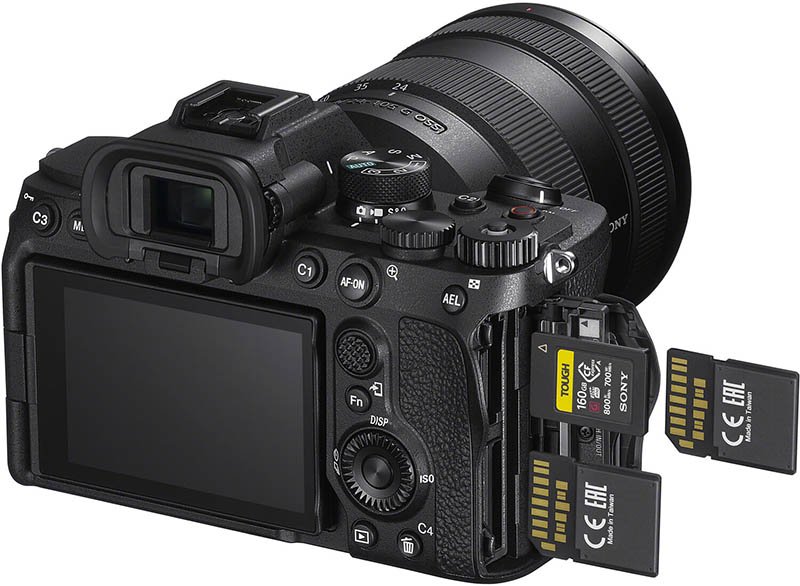
But first off, just in case you are unaware, the Sony A7 IV features two memory card slots.
Slot one is a dual slot that is compatible with the CFexpress Type A (2.0 & 4.0) cards and also SD/SDHC/SDXC (UHS-II / UHS-I) cards.
Slot two only supports SD/SDHC/SDXC (UHS-II / UHS-I) cards.

Table of Contents[Hide][Show]
- Introduction
- Best CFexpress Type-A Memory Cards
- Best UHS-II SD Memory Cards
- About These Tests
- Which Memory Cards are Supported?
- Max Burst by File Type & Buffer Clearing Times
- Memory Cards for Recording Video
- Memory Cards for S&Q Motion Shooting
- What Size Memory Card Do You Need?
- How Many Images Can Be Recorded on a Memory Card?
- Movie Record Times
- Simultaneous Recording Slot 1 + Slot 2
- Sort RAW / JPEG
- Dual Card Setup Guide
- Summary
- Sony A7 IV Guides & Resource
- FAQs
Introduction
The write speeds found on card labels don’t really help with understanding how the cards will perform when used in-camera, especially when they often display the maximum speeds and not sustained speeds.
I’ve therefore tested 51 memory cards to get the best possible idea of how they perform when used in the A7 IV.
Best CFexpress Type-A Memory Cards
In the below table you will find all of the CFexpress Type A cards that I have tested so far shooting Uncompress RAW + JPEG L (Extra Fine), since this combination pushes the camera and cards the hardest.
I have tested other file combinations but not for every card, please scroll down to Buffer Test – All File Types if interested.
You can comfortably shoot over 300 shots before filling the buffer when shooting in Uncompressed RAW + JPEG L (Hi+) with all but four of the CFexpress Type A cards tested. I don’t shoot more because I don’t think anyone is doing this in the real world.
Because their performance is so similar, I have grouped them by brand. Except for the slowest four cards that you will find at the bottom of the table.
These results are only valid for the card capacities tested, because sometimes write speeds can vary by capacity.
Swipe left on mobile to view the entire table.
| CFexpress Type A Memory Card | Shots to Fill Buffer * | Buffer Clearing Time in Seconds | Video Rating |
|---|---|---|---|
 Novachips Express 4.0 (1.6 TB) Amazon | Memory Wolf UK | 300+ | <2s | VPG400 |
 Novachips Express 4.0 (400 GB) Amazon | Memory Wolf UK | 300+ | <2s | VPG400 |
 Delkin Devices BLACK 4.0 (480 GB) Amazon | B&H Photo | Memory Wolf UK | 300+ | <2s | VPG200 |
 Delkin Devices POWER 2.0 (160 GB) Memory Wolf UK | 300+ | <2s | VPG400 |
 Nextorage NX-A2 PRO 4.0 (160 GB) Amazon | B&H Photo | 300+ | <2s | VPG400 VPG800 |
 Nextorage NX-AE 4.0 (500 GB) Amazon | B&H Photo | 300+ | <2s | VPG400 |
 Nextorage NX-A2SE 4.0 (512 GB) Amazon | B&H Photo | 300+ | <2s | VPG200 |
 SanDisk Pro Cinema 4.0 (480 GB) Amazon | B&H Photo | 300+ | <2s | VPG200 |
 ProGrade Digital Iridium 4.0 (480 GB) Amazon | B&H Photo | 300+ | <2s | VPG200 |
 Lexar Professional Gold Series 2.0 (160 GB) Amazon | B&H Photo | 300+ | <2s | VPG400 |
 Lexar Professional Silver Series 2.0 (320 GB) Amazon | 300+ | <2s | VPG200 |
 Lexar Professional GOLD 4.0 (256 GB) Amazon | B&H Photo | 300+ | <2s | VPG400 |
 Angelbird AV PRO 2.0 SE (160 GB) Amazon | B&H Photo | Memory Wolf UK | 300+ | <2s | VPG200 |
 Angelbird AV PRO 4.0 (256 GB) Amazon | B&H Photo | Memory Wolf UK | 300+ | <2s | VPG400 |
 OWC Atlas Pro 4.0 (240 GB) Amazon | B&H Photo | 300+ | <2s | VPG200 |
 Exascend Essential 2.0 (480 GB) Amazon | 300+ | <2s | VPG200 |
 Sony CEA-G Tough 2.0 (160 GB) Amazon | B&H Photo | 300+ | <2s | VPG400 |
 Sony CEA-G Tough 4.0 (240 GB) Amazon | B&H Photo | 300+ | <2s | VPG400 |
 Sony CEA-M Tough 2.0 (960 GB) Amazon | B&H Photo | 300+ | <2s | VPG200 |
 Lexar Professional SILVER 4.0 (256 GB) Amazon | B&H Photo | 283 | <2s | VPG200 |
 ProGrade Digital 2.0 Gold 2.0 (240 GB) Amazon | B&H Photo | 97 | 3s | VPG200 |
 Nextorage NX-A2SE 4.0 (256 GB) Amazon | B&H Photo | 29 | 3s | VPG200 |
 Pergear Master 4.0 (256 GB) Amazon | 15 | 3s | VPG200 |
Please note that the Nextorage NX-A2SE 4.0 (256 GB) card has a much slower sustained write speed than the larger 512 GB version which is why the buffer clears slower. The 256 GB card has a sustained write speed of 400 MB/s vs 850 MB/s for the 512 GB version. The max write speeds on the card labels are identical which makes it very confusing. The Pergear Master 4.0 256 GB also has a slower sustained write speed than the 512 GB version, hitting the buffer after only 15 shots. Subsequent bursts it manages 88 shots sometimes but it’s not consistent at all.
Best UHS-II SD Memory Cards
In this table you will find all of the UHS-II SD cards that I have tested in the Sony A7 IV shooting Uncompress RAW + JPEG L (Extra Fine), since this combination pushes the camera and cards the hardest.
I have tested other file combinations but not for every card, please scroll down to Buffer Test – All File Types if interested.
Unlike the CFexpress Type A cards, there is much more variance in performance. I have therefore ranked them by buffer clearing time.
Like with the CFexpress cards, the results are only valid for the card capacities tested.
Swipe left on mobile to view the entire table.
| UHS-II SD Memory Card | Shots to Fill Buffer * | Buffer Clearing Time in Seconds | Video Speed Class |
|---|---|---|---|
 Nextorage NX-F2 PRO (256 GB) B&H Photo | Amazon | 17 | 4.5s | V90 |
 SanDisk Extreme Pro (64 GB) B&H Photo | Amazon | Memory Wolf UK | 17 | 4.5s | V90 |
 Sony SF-G Tough (64 GB) B&H Photo | Amazon | Memory Wolf UK | 17 | 4.5s | V90 |
 Delkin Devices BLACK (64 GB) B&H Photo | Memory Wolf UK | 17 | 4.5s | V90 |
 Delkin Devices POWER (64 GB) B&H Photo | Amazon | Memory Wolf UK | 17 | 4.5s | V90 |
 ProGrade Digital V90 Iridium (128 GB) B&H Photo | Amazon | 17 | 4.5s | V90 |
 OWC Atlas Ultra (128 GB) B&H Photo | Amazon | 17 | 4.5s | V90 |
 Integral UltimaPro X2 (64 GB) Amazon | 17 | 4.5s | V90 |
 ProGrade Digital V90 300R (64 GB) B&H Photo | Amazon | 17 | 5s | V90 |
 Lexar Professional 2000X (64 GB) B&H Photo | Amazon | Memory Wolf UK | 17 | 5s | V90 |
 PNY EliteX-PRO 90 (64 GB) B&H Photo | Amazon | 15 | 5s | V90 |
 Angelbird AV Pro Mk 2 V90 (64 GB) B&H Photo | Amazon | Memory Wolf UK | 17 | 5s | V90 |
 Angelbird AV Pro Mk 2 V90 (128 GB) B&H Photo | Amazon | Memory Wolf UK | 17 | 5s | V90 |
 Transcend SD 700S (64 GB) B&H Photo | 17 | 5s | V90 |
 Kingston Canvas React Plus (64 GB) B&H Photo | Amazon | Memory Wolf UK | 15 | 5s | V90 |
 Exascend Catalyst (128 GB) B&H Photo | Amazon | 16 | 5.5s | V90 |
 Ritzgear Video Pro (64 GB) Amazon | 17 | 5.5s | V90 |
 Lexar Professional 1800X (64 GB) B&H Photo | Amazon | 16 | 6s | V60 |
 Sony SF-E (128 GB) B&H Photo | Amazon | Memory Wolf UK | 16 | 6s | V60 |
 Nextorage NX-F2 SE (512 GB) B&H Photo | Amazon | 16 | 6.5s | V60 |
 Sony SF-M Tough (128 GB) B&H Photo | Amazon | Memory Wolf UK | 15 | 7.5s | V60 |
 Sony SF-M (64 GB) B&H Photo | Amazon | 15 | 7.5s | V60 |
 ProGrade V60 (128 GB) B&H Photo | Amazon | 14 | 8s | V60 |
 Lexar Professional Silver Pro (128 GB) Amazon | 14 | 9s | V60 |
 Angelbird AV Pro MK2 V60 (64 GB) B&H Photo | Amazon | Memory Wolf UK | 14 | 11s | V60 |
 SanDisk Extreme Pro (64 GB) B&H Photo | Amazon | 14 | 12s | V60 |
 Lexar Professional 1667X (64 GB) B&H Photo | Amazon | Memory Wolf UK | 14 | 13s | V60 |
 Sony SF-E (64 GB) B&H Photo | Amazon | Memory Wolf UK | 13 | 15s | V30 |
About These Tests
All of my in-camera tests were carried out with the Sony A7 IV and firmware 4.00 whilst shooting in Uncompressed RAW + JPEG L (Extra Fine). All figures presented in this article are based on my test conditions.
You will most likely see slightly different results when running similar tests because a different scene will generate different file sizes. My test scene generated 70.1 MB Uncompressed RAW files and 23.7 MB JPEG L Extra Fine files.
When shooting with these file sizes in Hi+ (6 fps) the A7 IV is writing at an average speed of approximately 560 MB/s. It basically never fills the buffer because the fastest CFexpress cards are able to write fast enough to avoid filling it.
I chose to use Uncompressed RAW + JPEG L for my tests because this pushed the cards harder than testing with Compressed RAW + JPEG L, even with the frame rate at 10 fps.
My results are only valid for the card capacities tested, because sometimes write speeds can vary by capacity.
Which Memory Cards are Supported?
The Sony A7 IV has two memory card slots, here are the cards that each slot supports:
- Slot 1: CFexpress Type A (2.0 & 4.0) and UHS-I and UHS-II (SDHC/SDXC) SD cards
- Slot 2: Only UHS-I and UHS-II (SD/SDHC/SDXC) cards
CFexpress Type A 4.0 cards will work in the A7 IV because they are backwards compatible with the 2.0 standard, but you will not be able to take advantage of 4.0 speeds in-camera.
Max Burst by File Type & Buffer Clearing Times
I don’t test every single file type for every single card because I’d certainly lose the will to live.
But if you are interested, then here are the approximate figures when using the Novachips Express 4.0 400 GB card.
The JPEG Quality/HEIF Quality was [Extra Fine] and Image Size: [L:33M].
| File Type | Shots to Fill Buffer * | Buffer Clearing Time in Seconds |
|---|---|---|
| JPEG | 300+ | <2s |
| HEIF | 300+ | <2s |
| RAW & JPEG (RAW: Uncompressed) | 300+ | <2s |
| RAW & HEIF (RAW: Uncompressed) | 300+ | <2s |
| RAW (Uncompressed) | 300+ | <2s |
| RAW & JPEG (RAW: Compressed) | 300+ | <2s |
| RAW & HEIF (RAW: Compressed) | 300+ | <2s |
| RAW (Compressed) | 300+ | <2s |
| RAW & JPEG (RAW: Lossless Compressed L) | 300+ | <2s |
| RAW & HEIF (RAW: Lossless Compressed L) | 300+ | <2s |
| RAW (Lossless Compressed L) | 300+ | <2s |
| RAW & JPEG (RAW: Lossless Compressed M) | 300+ | <2s |
| RAW & HEIF (RAW: Lossless Compressed M) | 300+ | <2s |
| RAW (Lossless Compressed M) | 300+ | <2s |
| RAW & JPEG (RAW: Lossless Compressed S) | 300+ | <2s |
| RAW & HEIF (RAW: Lossless Compressed S) | 300+ | <2s |
| RAW (Lossless Compressed S) | 300+ | <2s |
Memory Cards for Recording Video
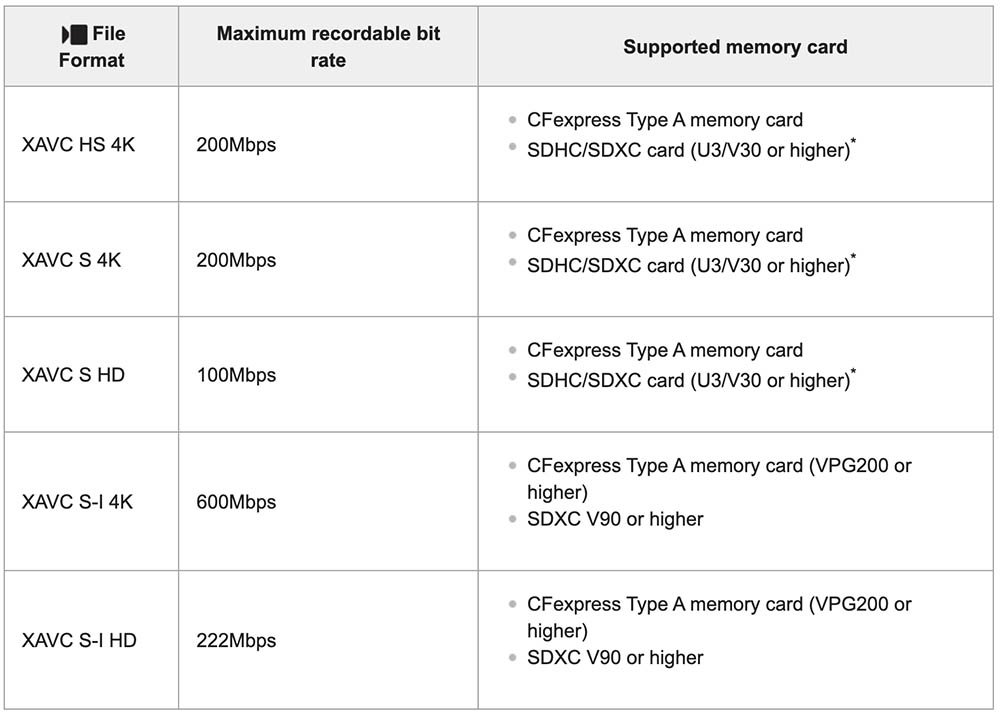
The Sony A7 IV supports a number of different movie recording formats. The format that you choose to record in will determine the memory cards that you use. Here’s a list or supported recording formats and compatible memory cards for the A7 IV.
Memory Cards for S&Q Motion Shooting
Here you can find a list of supported recording formats and compatible memory cards for S&Q motion shooting with the A7 IV.
You will only require a CFexpress Type-A card when shooting in S&Q Mode with the file format set to XAVC S-I 4k, a record frame rate of 25p and a frame rate of 50fps (2x slow motion).
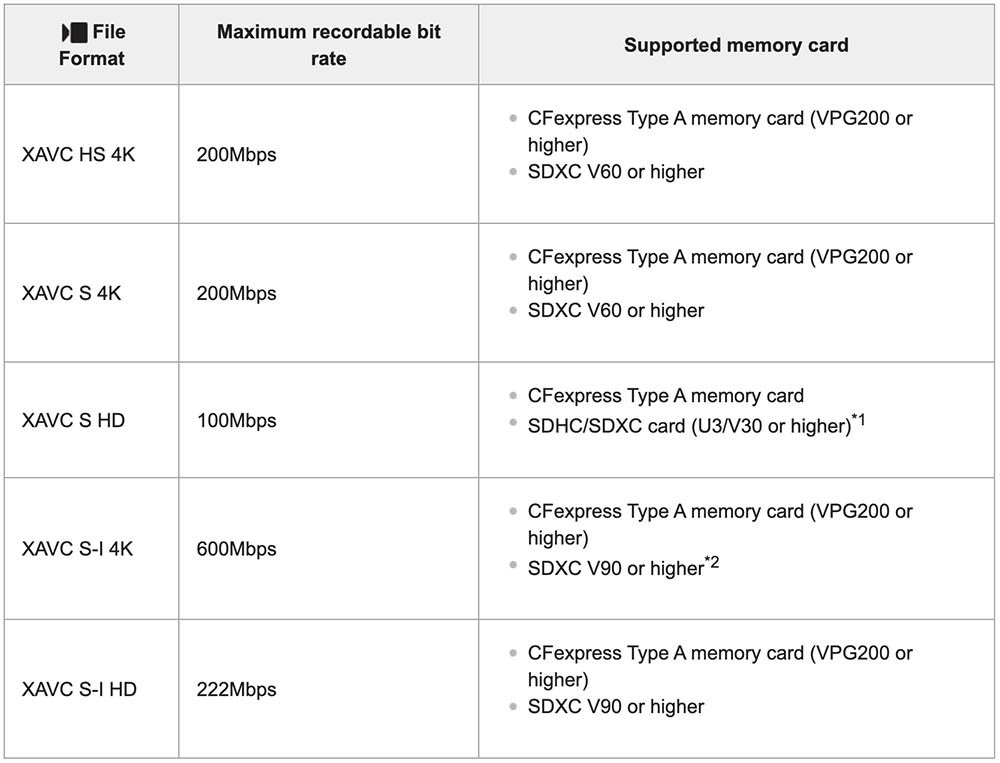
*1 When [Rec Frame Rate] is set to [30p]/[25p]/[24p], [Frame Rate] is set to [120fps]/[100fps], and the recordable bit rate is set to 50 Mbps, an SDXC card (V60 or higher) or a CFexpress Type A memory card (VPG200 or higher) is required.
*2 When [Rec Frame Rate] is set to [30p]/[25p]/[24p] and [Frame Rate] is set to [60fps]/[50fps] for slow-motion recording, a CFexpress Type A memory card (VPG200 or higher) is required.
What Size Memory Card Do You Need?
If you will be shooting a lot of continuous bursts then you will probably want to use at least a 160GB CFexpress card.
If you are not shooting long continuous bursts then you’ll probably be fine with 32GB or 64GB cards and you certainly won’t need the faster CFexpress Type A cards.
For shooting video the size of memory card will depend largely on the format that you are recording in. Or you may be using an external recorder anyway so this won’t be so important.
I’d recommend only using SDXC cards and not SDHC. 32GB cards and smaller are SDHC and use the FAT32 file system. If you shoot video with a SDHC card your files will be split into 4GB chunks which creates extra work in post production.
How Many Images Can Be Recorded on a Memory Card?
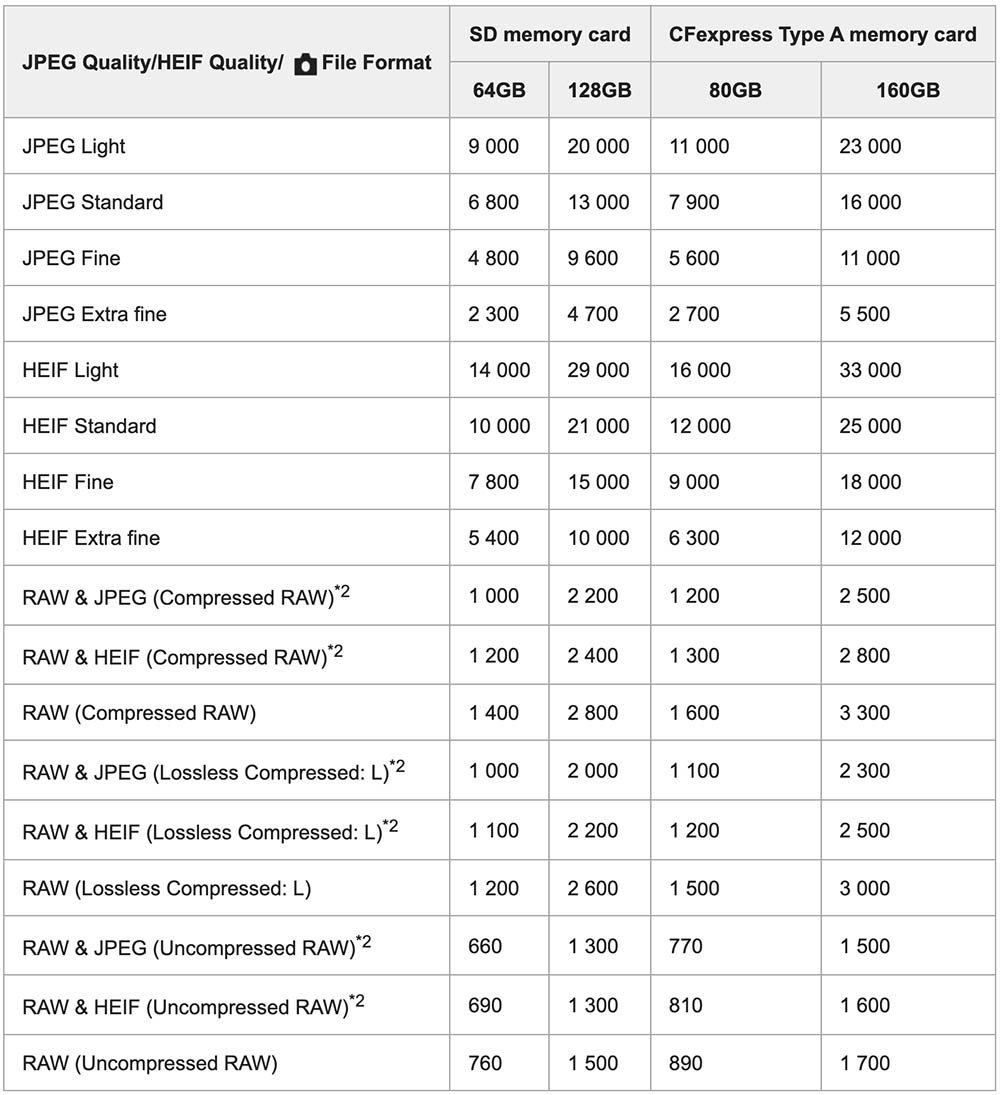
The table below shows the approximate number of images that can be recorded on a memory card formatted in the A7 IV when using a Sony memory card with the aspect ratio set to 3:2 and JPEG/HEIF size set to L:33M.
The values may vary depending on the shooting conditions and the type of memory card used.
Movie Record Times
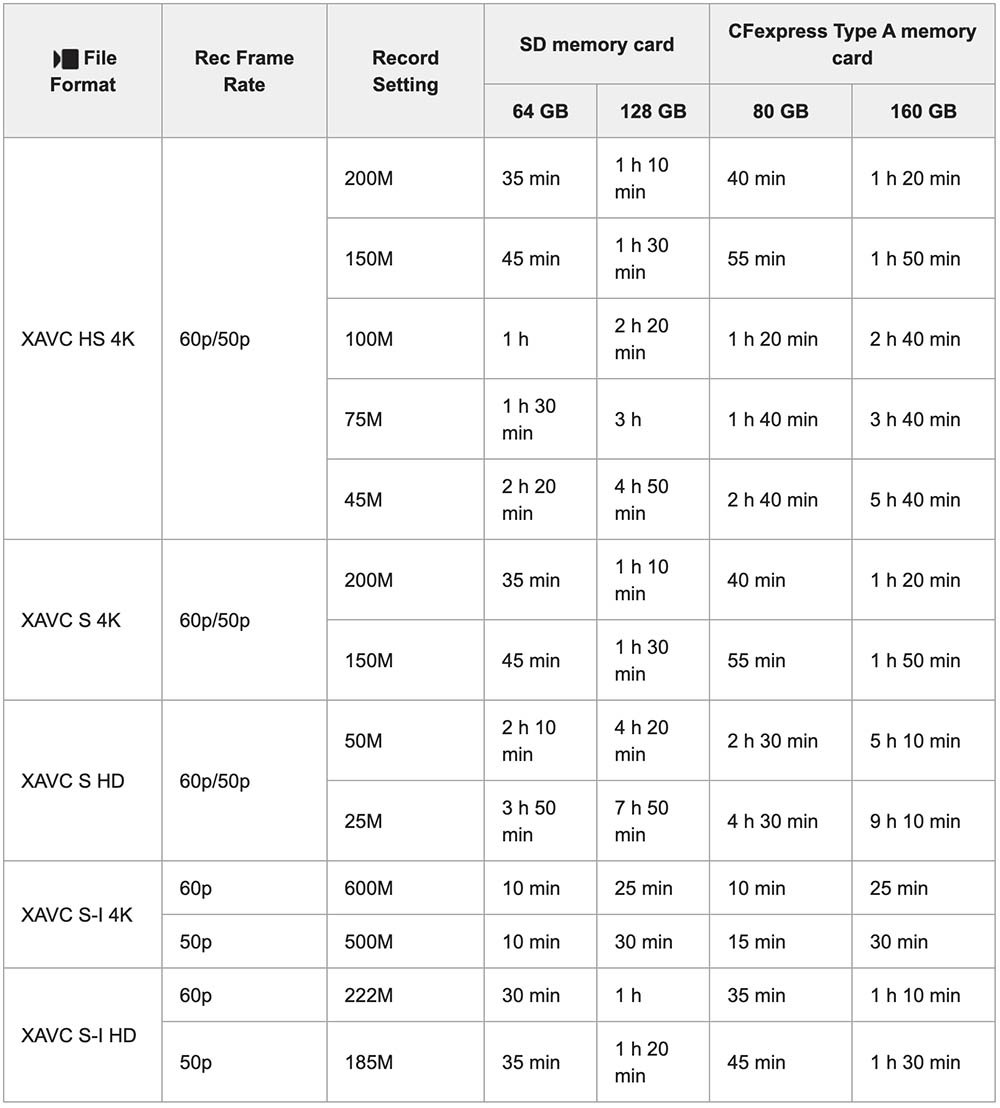
The table below shows the approximate total recording times using a Sony memory card formatted in the Sony A7 IV. The values may vary depending on the shooting conditions and the type of memory card used.
Simultaneous Recording Slot 1 + Slot 2
If you want to record simultaneously to both slots 1 and 2 at the same time then there is no benefit to using a CFexpress Type-A memory card in slot 1.
With this setup the write speed is restricted to the maximum write speed of the UHS-II card in slot 2.
The only benefit to using a CFexpress Type-A card when shooting simultaneously is to enjoy the faster read times when copying the files to your computer.
Providing you are using identical UHS-II cards in both slots then the number of shots that you can take and the buffer clearing time will be the same as writing to a single slot.
If one of the UHS-II cards is slower then you will be limited to the speed of that card.
Sort RAW / JPEG
You can also setup your A7 IV to record RAW files to slot 1 and JPEG files to slot 2. With this setup there is still a benefit to using a CFexpress card in slot 1.
If you are shooting with a fast CFexpress card and a fast V90 UHS-II card you should be able to shoot over 300+ shots without hitting the buffer.
Dual Card Setup Guide
If you are not sure how to setup dual card recording with the Sony A7 IV then you might find my short video guide helpful.
Memory Card Readers
Mixing memory card and card reader brands often works without issue, but compatibility problems can occasionally occur.
Therefore, I recommend using a card reader that matches your memory cards to reduce the risk of incompatibility. For example, if you use ProGrade memory cards, I’d recommend a ProGrade card reader; if you use Lexar cards, a Lexar reader is the best choice, and so on.
Also keep in mind that transfer speeds will always be limited by either the reader or the maximum card speeds. So don’t be tricked into buying a reader that advertises faster transfer speeds than the cards it supports.
You will see figures like 10 Gb/s, 20 Gb/s or 40 Gb/s. These are the maximum bus speeds for the device. It’s important to note the lowercase b which indicates that this figure is Gigabits per second and not Gigabytes per second. 10 Gb/s = 1250 MB/s.
CFexpress Type A 4.0 Readers
These CFexpress readers support the faster CFexpress Type A 4.0 speeds, they are also backwards compatible with CFexpress Type A 2.0 cards.
| CFexpress Type A 4.0 Reader | * Max Transfer Speed | Price Check |
|---|---|---|
| ProGrade Digital CFexpress 4.0 | 2000 MB/s | B&H Photo | Amazon |
| Nextorage NX-SA1PRO CFexpress 4.0 | 2000 MB/s | B&H Photo | Amazon |
| Novachips CFexpress 4.0 | 2000 MB/s | Memory Wolf UK | Amazon |
| Sony MRW-G3 CFexpress 4.0 | 2000 MB/s | B&H Photo | Amazon |
| Lexar Professional Workflow 4.0 | 2000 MB/s | B&H Photo | Amazon |
CFexpress Type A 2.0 Readers
These CFexpress readers support CFexpress Type A 2.0 speeds, they compatible with CFexpress Type A 4.0 cards but will only transfer data at 2.0 speeds.
| CFexpress Type A 2.0 Reader | * Max Transfer Speed | Price Check |
|---|---|---|
| Angelbird PKT CFexpress 2.0 | 1000 MB/s | B&H Photo | Amazon |
CFexpress Type A 2.0 + SD Dual Slot Readers
These dual readers support CFexpress Type A 2.0 cards, they are compatible with CFexpress Type A 4.0 cards but will only transfer data at 2.0 speeds. They also support SD/SDHC/SDXC (UHS-II / UHS-I) memory cards.
| CFexpress Type A 2.0 + SD Reader | * Max Transfer Speed | Price Check |
|---|---|---|
| Sony MRW-G2 | 1000 MB/s | B&H Photo | Amazon |
| ProGrade Digital | 1000 MB/s | B&H Photo | Amazon |
| Lexar Professional | 1000 MB/s | B&H Photo | Amazon |
UHS-II SD Card Readers
These card readers only support SD/SDHC/SDXC (UHS-II / UHS-I) memory cards.
| UHS-II SD Card Reader | * Max Transfer Speed | Price Check |
|---|---|---|
| Lexar Professional Workflow Dual-Slot | 312 MB/s | B&H Photo | Amazon |
| SanDisk Extreme Pro SD Card USB Type-C | 312 MB/s | B&H Photo | Amazon |
| Kingston Mobilelite Plus | 312 MB/s | B&H Photo | Amazon |
| Sony MRW-S1 UHS-II SD Memory Card Reader | 312 MB/s | B&H Photo | Amazon |
Summary
As you are now probably well aware, there are a lot of CFexpress Type A and UHS-II SD cards on the market, figuring out the best ones for your needs and budget can be a challenge.
However, with the performance of most CFexpress Type A cards very similar, you might simply want to just go with your favorite brand, or the ones that matches your budget.
Nextorage is definitely a brand worth considering. They are a Japanese company run by former Sony employees and their cards are seriously good.
Novachips are also not very well known but offer some brilliant cards with great prices. They are probably the best performing and best value CFexpress Type A card currently available. Novachips is a South Korean company.
I’m also a big fan of the Delkin cards. They have excellent lifetime warranties and their BLACK cards also come with a 48-hour replacement guarantee in addition to their limited lifetime warranty policy. They also have US and European based support teams.
If you have any questions or can share any feedback on the cards I have tested or cards that I haven’t, please do drop a comment a below.
If you are in the UK please consider purchasing from Memory Wolf which is a store that I also run.
Thanks for reading!
Table of Contents[Hide][Show]
- Introduction
- Best CFexpress Type-A Memory Cards
- Best UHS-II SD Memory Cards
- About These Tests
- Which Memory Cards are Supported?
- Max Burst by File Type & Buffer Clearing Times
- Memory Cards for Recording Video
- Memory Cards for S&Q Motion Shooting
- What Size Memory Card Do You Need?
- How Many Images Can Be Recorded on a Memory Card?
- Movie Record Times
- Simultaneous Recording Slot 1 + Slot 2
- Sort RAW / JPEG
- Dual Card Setup Guide
- Summary
- Sony A7 IV Guides & Resource
- FAQs
Sony A7 IV Guides & Resource

FAQs
The Sony A7 IV supports CFexpress Type A memory cards in slot 1 only. UHS-I and UHS-II SD cards are also supported in both slot 1 and slot 2.
No.
Sometimes if the card has been used in another device it won’t be recognised. Try using a card reader to format or remove all files and folders with a computer, then try it again in the camera.


Excellent review!
Hey,
Mind Testing using a CFexpress A and a V90 card together? Shooting Raw to one and Jpg to the other (Can you shoot compressed raw to the one and full to the other? if so that too please)
I just want to see how resonable it is to shoot Raw+ Jpg if I’m doing something I need a long burst for (Honestly, I’ve never even hit the buffer on my A7iii using v30 cards, but would still be nice to know in the mean time)
Hi William. I have already tested this type of setup.
If you use a CFexpress Type-A card in slot 1 then providing you record either uncompressed or compressed raw to slot 1 and JPEGs to slot 2, you will never hit the buffer when shooting continuously. However, you must be using one of the faster UHS-II cards in slot 2 like the Kingston Canvas React Plus UHS-II or Sony SF-G Tough cards. Slower cards like the Sony SF-M cards will cause the buffer to be hit.
If you use UHS-II cards in both slots and want to shoot uncompressed or compressed raw to slot 1 and JPEGs to slot 2 you will hit the buffer after around 26 shots (uncompressed raw) or 67 shots (compressed raw).
Hope that helps!
Hi Timothy
Fantastic information here, thanks so much!
But my experience does differ a little for this set up. I do hit the buffer when recording compressed raw to a Pergear Professional CFexpress Type A 520GB card in slot 1, plus JPEG extra fine to a Kingston Canvas React Plus v90 card in slot 2. The camera then drops from 10 frames per second to around 6 frames per second. If I drop from JPEG extra fine to JPEG fine in slot 2, but still 33MP, then I never hit the buffer.
If I only use slot 1 without slot 2 then I never hit the buffer recording compressed raw to to Pergear card, and also never hit the buffer recording JPEG extra fine to the Kingston card, so I guess it’s camera processing rather than write speed causing this?
I can confirm that I am using a Pergear Professional (Prime) card as you did, not a Pergear Standard card.
Hi Timothy,
great comparison! May I ask how you tested all that? Your measurements are very detailed, so I’m wondering about your test procedure. I searched in the text, but couldn’t find it.
I was thinking about doing a test for the ones I bought, particularly my Sony tough cards, which seem to have an issue (at least they do on the computer and they also seem to lag at times). My approach would be filming with a smartphone at high fps and then analyzing in premiere pro.
Any input would be greatly appreciated. Thank you!
Hi Wolfgang. I’m glad that you liked the comparison. The tests are quite simple. I shoot the same test scene (a book cover) that provides enough detail to simulate a typical shot, this is more important for the compressed file types than uncompressed. I fire off a burst of shots before starting the test because for some reason the first write is often much slower than subsequent writes for many of the cards I’ve tested.
I then press the shutter button and time how long it takes before the buffer is full. I also time how long it takes for the buffer to clear. I repeat this test until I get 3 results with the identical number of shots taken. I then average the buffer clearing time and total time of these results. I calculate the average in-camera write speed by taking the number of shots, multiplying this by the file size then dividing by the total time taken to shoot and clear the buffer.
There was a recall for some of the older Sony Tough cards that had issues. Further details here: https://www.alphashooters.com/sony-memory-card-replacement-program-june-2020/
Thanks Timothy for great contest and all your efforts for this website.
I’m wondering how the Kodak UHS-II v90 performs comp[are to other brands you tested.
If you can add that test results for that which has resonably priced for a V90 memory that would be awesome!
Thanks Ehsan. I’ve not tested the Kodak UHS-II v90 so can’t comment on its performance I’m afraid. I will look into adding it to my future tests though.
Has anyone experienced significant lag when trying to review photos on uhs-ii cards? I purchased a used a7iv that works perfectly, except for a 3-6 seconds lag when trying to review pictures as well as switching back to photo mode from preview mode. I’m wondering if I was sold a lemon.
Did you resolve this Jesse? Try changing your Auto Review settings. MENU → (Setup) → [Display Option] → [Auto Review] → desired setting. Personally I prefer it turned off.
Hi Timothy, great article. I was wondering if the write speed of the SD/Cfe-A cards slows down once the card is filling up. That is something that is often observed with SSDs in computers. Basically, is the write speed still the same for a card at e.g. 80% vs 0% storage capacity?
Given the current prices, many will be inclinded to go for a smaller/cheaper card. However, if that comes with a drop in burst rate duration, it might be important to factor that into the purchasing decision. For instance, sport events like cycling often require the sustained burst rate for the finish line shots at the end of the race, when the SD card is likely not empty anymore. Curious to hear what you think. Best, Matt
Not that I’ve seen Matt although I have not testes this extensively. Thankfully the price of CFexpress Type-A cards is coming down slowly as more manufacturers enter this space.
Hi Timothy, thanks so much for all your tests. Quick question about the buffer clearance. On my old a7RM2, the camera is completely ‘locked’ while the buffer is clearing. Can you please confirm that on the a7M4 one can a) acess the menu (e.g. changing the focus mode) while the buffer is clearing and b) start taking new pictures while the buffer is still clearing? For instance, it might take ~6 sec for the buffer to clear completely. I wonder if it’s possible to start shooting after 3 sec already; at that point the buffer is not cleared entirely, but should already have capacity for new images. Or does one have to wait until the buffer is cleared completely before taking new images? Appreciate your help, Matt
Hi Matt. Yes you can shoot whilst the buffer is clearing but obviously only until the buffer is full again.
Thank you for the great article – very helpful!
By any chance, have you done any tests to see if the SD/CFe write speeds slow down once the card is getting 50%, 70%, 90% full? Or any guess maybe, given that this behavior is also seen with normal SSDs?
People using the camera for sporting events, or bursts in general, might be surprised if the buffer capacity is is all of a sudden deminished in the later stages of a sport event (when the card storage is nearly full).
I am asking, because that might actually impact my decision to opt for a card with more storage, despite the price penalty.
Curious what you think,
Matt
Hi Matt. Sorry I’ve only just seen this comment. I’ve not done any extensive testing here but it a quick test I didn’t notice the frame rate slowing down as the card neared its full capacity.
Hi Timothy,
thank you so much for this test!
I have a question about the card slot write speeds… Sony says, that both slots support UHS-II but when I shoot on the second slot I can shoot way longer (like you tested) in burst mode and if I shoot on the first slot, it seems like it only has the speed off an UHS-I card… Is there an issue with my camera/SD Card or can you confirm this?
I use a SanDisk Extreme Pro 32GB SDHC II 300MB/s
best regards Darius
Hi Darius. Providing you are using the same card (as you are) and also have the camera setup to record the same image type to slot 1 or slot 2, then there really is no reason why one slot would be slower than the other. If you had it setup to record say uncompressed RAW images to slot 1 but JPEGS to slot 2 then you would see a big difference in the time taken to clear the buffer.
Ok thanks 🙂 than my camera seems to be a case for Sony guarantee 🙁
Hi, I just newly brought the Sony A7iv i want to know that can I use CF EXPRESS TYPE A card in both slot? I use this camera for videos mostly plz let me know thanks
Hi Badir. Only slot 1 supports CFexpress Type-A cards I’m afraid. You’ll need to use an SD card in slot 2, something like the Kingston Canvas React Plus UHS-II card.